
How DME Billing Services Help Reduce Claim Denials
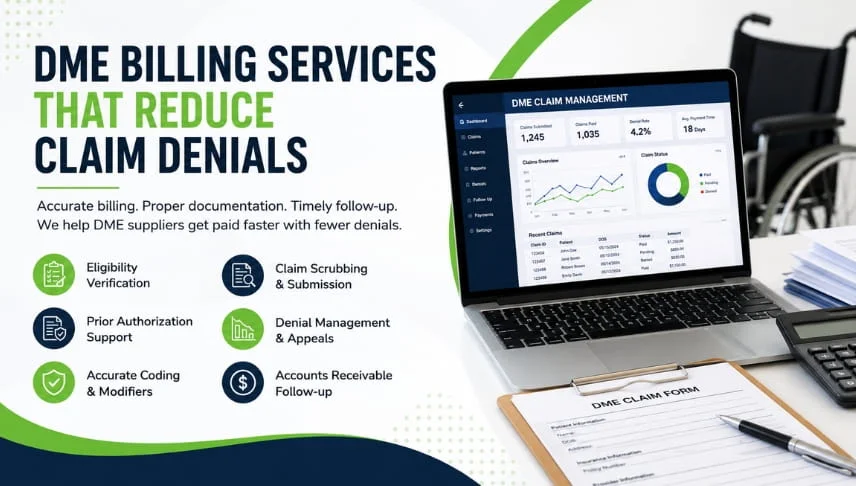
Every denied claim delays payment for equipment that has already been delivered and increases the workload of the billing team. When denials become frequent, the cause is often linked to incorrect eligibility information, incomplete medical documentation, coding errors, missing modifiers, authorization issues, or weak claim follow-up.
DME billing services help suppliers prevent these problems before claims are submitted. They review payer requirements, verify documentation, check codes and modifiers, correct avoidable errors, and monitor unpaid claims. This structured billing process reduces denials, supports faster reimbursement, and helps maintain more consistent cash flow.
How Do DME Billing Services Reduce Claim Denials?
DME billing services reduce claim denials by verifying patient eligibility, reviewing coverage requirements, checking medical necessity documentation, and using the correct HCPCS codes and modifiers. They also confirm prior authorization details, prepare accurate claims, and follow payer guidelines to prevent common billing errors before submission.
This prevention-focused process helps DME suppliers protect cash flow and avoid unnecessary payment delays. Instead of waiting for a claim to be denied, an experienced billing team reviews each claim in advance, corrects missing or inaccurate information, and follows up on payer responses to support faster reimbursement.
How DME Billing Services Help Reduce Claim Denials
Reducing DME claim denials requires more than correcting rejected claims after submission. A reliable billing process checks every important detail before the claim reaches the payer. The following steps explain how DME billing services prevent common errors, improve claim accuracy, reduce payment delays, and support consistent reimbursement.
1. Patient Eligibility Is Verified Before Equipment Delivery
Eligibility verification prevents claims from being submitted to inactive plans, incorrect payers, or policies that do not cover the requested equipment. Before delivery, the billing team confirms essential insurance details, including:
Active coverage and effective dates
Primary and secondary payer information
Deductible and coinsurance amounts
DME benefit limitations
Rental, purchase, and authorization rules
2. Prior Authorization Requirements Are Checked Early
Some DME items require payer approval before they can be delivered or billed. The billing team checks authorization requirements early and tracks:
Required clinical documents
Approved HCPCS codes and quantities
Authorization reference numbers
Valid service dates
Frequency limits and renewal rules
3. Medical Necessity Documentation Is Reviewed
A physician’s order alone may not be enough to support payment. The medical record must explain why the equipment is reasonable and necessary for the patient’s condition. DME billing specialists review diagnoses, symptoms, functional limitations, previous treatments, clinical findings, expected use, and length of need. Missing information is requested before submission, reducing medical-necessity denials and documentation requests.
4. Standard Written Orders Are Checked for Missing Details
A valid Standard Written Order is an important requirement for many DME claims. Billing specialists check the patient’s name, order date, equipment description, quantity, practitioner details, signature, frequency of use, and duration of need. For items requiring an order before delivery, the document must be completed on time to prevent denials caused by missing, incomplete, or late orders.
5. HCPCS Codes and Modifiers Are Validated
Accurate HCPCS codes and modifiers tell the payer what equipment was supplied and under which billing conditions. DME billing teams review product descriptions, rental or purchase status, units, place of service, frequency limits, replacement rules, and payer-specific coding policies. They also confirm required modifiers, reducing denials caused by mismatched codes, missing modifiers, or incorrect billing classifications.
6. Ordering Provider Information Is Confirmed
Ordering provider information must match the details available in the payer’s records. DME billing specialists verify the provider’s legal name, NPI, enrollment status, specialty, ordering authority, and signature requirements. For Medicare claims, PECOS information may also be reviewed. Correcting inconsistencies across the order, medical record, and claim prevents enrollment-related denials and unnecessary reimbursement delays.
7. Proof of Delivery Is Collected and Stored
Proof of delivery confirms that the patient received the equipment or supplies included on the claim. Medical billing teams organize records containing the patient’s name, delivery address, item description, quantity, delivery date, signature, tracking information, and supplier details. Connecting this documentation with the correct patient account makes it easier to respond to payer reviews, audits, and additional documentation requests.
8. Claims Are Scrubbed Before Submission
Claim scrubbing identifies missing, invalid, or inconsistent information before a claim reaches the payer. The billing team reviews:
Patient and insurance details
Diagnosis and HCPCS codes
Required modifiers
NPI and authorization numbers
Dates of service and units
Duplicate claims and attachments
9. Payer Rules and Coverage Policies Are Monitored
DME coverage and billing rules may change as payers update medical policies, authorization lists, documentation standards, fee schedules, and coding instructions. Billing specialists monitor these changes and update internal workflows. They also review Medicare coverage guidance, including national and local policies, reducing denials caused by outdated codes, expired forms, missing modifiers, or old documentation requirements.
10. Denials Are Categorized by Root Cause
Denial management becomes more effective when claims are categorized according to their root cause. Billing teams group denials related to eligibility, authorization, coding, documentation, medical necessity, provider enrollment, duplicate billing, timely filing, proof of delivery, and coordination of benefits. Reviewing these patterns reveals repeated workflow problems and helps suppliers correct them before the same issue affects more claims.
11. Denied Claims Are Corrected and Appealed Without Delay
A denied claim should be reviewed quickly instead of being written off without investigation. The billing team examines the remittance advice, identifies reason and remark codes, reviews the original claim, gathers missing records, and determines whether correction, resubmission, reopening, or appeal is appropriate. Timely action matters because payer deadlines vary, and delayed responses can reduce payment recovery opportunities.
12. Accounts Receivable Follow-Up Prevents Unpaid Claims From Being Forgotten
Some claims remain pending, under review, or unpaid without receiving a clear denial. Regular accounts receivable follow-up keeps these claims from being overlooked. DME billing services track unprocessed claims, documentation requests, underpayments, recoupments, appeals, secondary claims, and patient balances. They contact payers, record reference numbers, submit requested information, and schedule the next action to protect earned revenue.
Benefits of Reducing DME Claim Denials
Reducing DME claim denials improves payment consistency and helps suppliers maintain a more stable revenue cycle. It also reduces unnecessary administrative work, prevents repeated billing mistakes, and allows staff to focus on accurate claim processing. DME suppliers can achieve several important operational and financial benefits, including:
More predictable monthly cash flow
Less administrative rework for billing staff
Faster and more consistent claim reimbursement
Lower overall claim processing costs
Better compliance with payer requirements
Stronger preparation for billing audits
Clearer and more useful performance data
Fewer repeated coding and documentation errors
In-House Billing vs. Outsourced DME Billing Services
The billing model depends on staff expertise, claim volume, available resources, payer requirements, and revenue cycle goals. Both in-house and outsourced billing can support accurate claims, consistent follow-up, and better reimbursement when managed through reliable processes.
In-House DME Billing
An in-house billing team gives suppliers direct control over billing operations and internal communication. It can be effective when trained staff, updated technology, payer knowledge, and enough time for claim submission, denial management, and accounts receivable follow-up are available. However, it may require ongoing spending on salaries, training, software, and staff coverage.
Outsourced DME Billing Services
Outsourced DME billing services provide access to experienced specialists who understand coding, modifiers, payer policies, authorization requirements, documentation, and denial management. They can reduce administrative workload, improve billing consistency, and help suppliers focus on patient service and business growth. Outsourcing may be useful for suppliers facing:
Increasing claim denial rates
Delayed or inconsistent payments
High accounts receivable balances
Frequent staff turnover
Limited claim follow-up
Coding and modifier errors
Missed authorization requirements
Incomplete documentation
Expansion into new payer networks
Why Choose AIHS as Your DME Billing Company?
Advanced IT & Healthcare Solutions (AIHS) helps DME suppliers manage complex billing tasks with greater accuracy and consistency. Our team focuses on reducing preventable denials, improving claim follow-up, and supporting a smoother revenue cycle from eligibility verification through payment collection. DME suppliers choose AIHS for:
Accurate insurance eligibility verification
Careful HCPCS code and modifier review
Prior authorization and documentation support
Clean claim submission and claim scrubbing
Timely denial correction and appeals
Consistent accounts receivable follow-up
Clear billing reports and performance insights
Support for old and unpaid claims
Secure handling of patient billing information
Responsive communication with supplier teams
Final Thoughts
Claim denials affect more than billing performance. They can negatively affect cash flow, increase staff workload, delay patient communication, and limit business growth. DME billing services help prevent these issues by checking eligibility, confirming authorizations, reviewing documentation, validating codes and modifiers, and submitting cleaner claims from the beginning.
A structured billing process reduces avoidable errors, improves reimbursement speed, and limits repeated corrections or appeals. Advanced IT & Healthcare Solutions supports DME suppliers with claim submission, denial follow-up, accounts receivable, eligibility verification, coding review, and revenue cycle management. Call +1 (469) 454-6966 or email admin@mymedicalbillingrcm.com.
Frequently Asked Questions
What Are the Most Common Reasons for DME Claim Denials?
DME claims are commonly denied because of inactive insurance coverage, missing prior authorization, incomplete medical necessity records, incorrect HCPCS codes, invalid modifiers, missing written orders, provider information errors, or incomplete proof of delivery.
How Do DME Billing Services Reduce Claim Denials?
DME billing services verify eligibility, review documentation, confirm authorization, validate codes and modifiers, and check claims before submission. They also monitor payer responses and correct billing issues before they cause longer payment delays.
What Documentation Is Required for a DME Claim?
A DME claim may require a Standard Written Order, medical records supporting necessity, correct coding, and proof of delivery. Certain equipment may also require a face-to-face encounter, prior authorization, or a written order before delivery.
Does Prior Authorization Guarantee DME Claim Payment?
Prior authorization does not automatically guarantee payment. The submitted claim must still meet the payer’s eligibility, coverage, coding, documentation, quantity, and service-date requirements. Incorrect or inconsistent information can result in a denial even when authorization was obtained.
Can a Denied DME Claim Be Corrected or Appealed?
Yes. Depending on the denial reason and payer rules, a claim may be corrected, resubmitted, reopened, or appealed. The billing team should review denial codes, collect supporting records, and respond within the payer’s filing deadline.