
ICD 10 Code for Headache: 2026 Coding and Medical Billing Guide
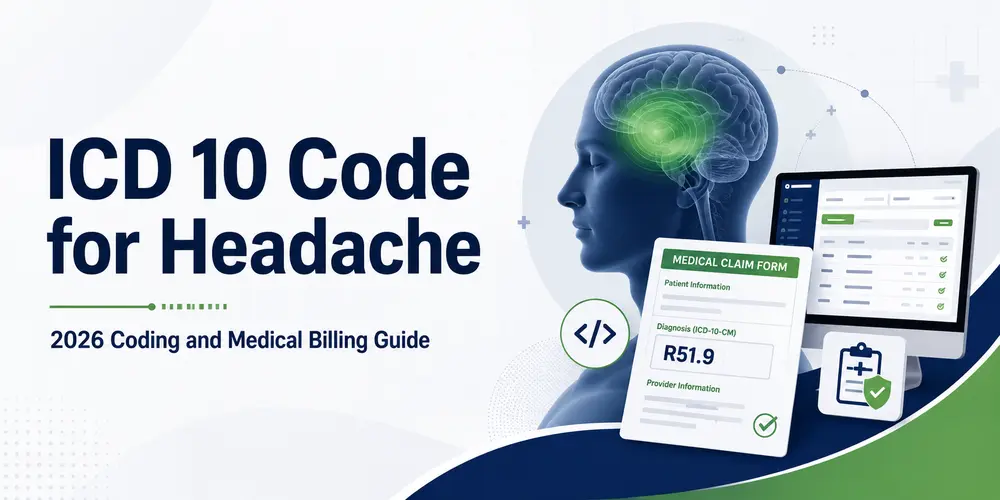
The ICD 10 code for headache is not a single answer for every encounter. R51.9, Headache, unspecified, is the billable choice when the clinician documents a headache but has not established a more defined disorder or cause. Once the record supports migraine, tension-type headache, cluster headache, post-traumatic headache, cervicogenic headache, or another named condition, the claim should reflect that diagnosis at the highest supported level of detail. The financial risk comes from guessing specificity, using an incomplete code, or pairing a valid diagnosis with a service that the payer does not consider medically necessary.
What Is the ICD-10 Code for Headache?
R51.9 is the ICD-10-CM code for headache, unspecified. It is billable when headache is the confirmed symptom for the encounter and the provider has not documented a more specific headache diagnosis. Do not use R51.9 in place of a supported migraine, tension-type, cluster, post-traumatic, orthostatic, or cervicogenic headache code.
R51.9 ICD 10 Meaning and Billable Status
R51.9 means Headache, unspecified. It belongs to Chapter 18 of ICD-10-CM, which covers symptoms, signs, and clinical findings not classified elsewhere. The code describes the symptom reported and assessed during the encounter. It does not identify a migraine subtype, headache mechanism, underlying disease, level of severity, or response to treatment.
R51.9 is a valid billable code because it contains the characters required for claim reporting. R51 alone is a parent category, not a reportable diagnosis code, because that category is divided into R51.0 and R51.9. Submitting R51 can trigger a front-end edit for an incomplete or invalid diagnosis.
R51.9 is not automatically a poor code. The FY 2026 official guidelines state that symptom codes are acceptable when the provider has not confirmed a related diagnosis. The same guidelines say that an unspecified code can be the most accurate choice when the record does not contain enough information for a more specific code. Coders should never infer a clinical diagnosis solely to make a claim appear more detailed.
Headache ICD 10 Code Matrix
The table below gives a practical view of commonly searched headache codes. It is an educational reference, not a substitute for the current code set, payer policy, or qualified coding review.
Two search terms require correction. G43.70 is a subcategory, not the final code for a claim; additional characters are needed to report intractability and status migrainosus. G44.381 is not a current FY 2026 reportable code. Post-traumatic headache coding uses the G44.30, G44.31, or G44.32 families, followed by the characters required for intractability and, when documented, acute or chronic status.
When Is R51.9 Appropriate for Headache Billing?
Use R51.9 when headache is evaluated but the provider has not confirmed a more specific disorder. Examples include a new headache with pending workup, an urgent care assessment that remains “headache,” or pain with no documented migraine, trauma relationship, postural component, or named syndrome.
In outpatient coding, “rule out,” “probable,” and “suspected” diagnoses are not reported as confirmed. If the final assessment says “rule out migraine” and establishes only headache, R51.9 may be accurate. Symptoms such as nausea, throbbing pain, or light sensitivity do not permit a coder to create a migraine diagnosis. Query the provider when clinically important detail conflicts with the assessment.
Headache Symptom Code vs. Confirmed Diagnosis Code
The decision is based on what the provider established for the date of service. R51.9 can represent undifferentiated headache when no related diagnosis is confirmed. If the clinician documents migraine, review G43 for aura, chronicity, intractability, and status migrainosus. Tension-type, cluster, post-traumatic, and other syndromes generally point to G44. A confirmed secondary cause may become the central diagnosis under applicable sequencing rules.
Headache is generally inherent in a diagnosed headache disorder. Official guidelines say symptoms routinely associated with a confirmed disease are not normally reported separately unless the classification instructs otherwise. A claim should not automatically contain both R51.9 and a migraine code.
Unspecified does not mean inaccurate. If the record lacks a required clinical detail, follow the documentation and indexing rules. Selecting aura or intractability without support creates audit exposure and may conflict with coverage criteria.
Advanced IT & Healthcare Solutions connects this code-selection work with documentation review, claim edits, and denial analysis through its medical coding services. That connection matters because a technically valid diagnosis can still fail when it does not match the service, authorization, or clinical note.
Different ICD-10 Codes for Headache Types
Migraine ICD 10 codes
Migraine codes sit in G43. Selection may depend on type, aura, chronicity, intractability, and status migrainosus. Do not treat “severe” and “intractable” as interchangeable. Intractability should be stated by the provider; a coder should not derive it from pain score or medication history alone.
G43.909 covers unspecified migraine, not intractable, without status migrainosus. G43.109 covers migraine with aura under the same non-intractable and no-status conditions. Chronic migraine without aura requires a final code such as G43.701, G43.709, G43.711, or G43.719.
Tension-Type Headache ICD 10 Codes
Tension-type headaches fall under G44.2. The family distinguishes episodic, chronic, or unspecified forms and intractability. G44.209 is the unspecified, not-intractable option. Use a more exact child code when the provider documents the needed facts.
Cluster Headache ICD 10 Codes
Cluster headache syndrome falls under G44.0. Selection can reflect episodic, chronic, or unspecified cluster headache and intractability. G44.009 represents the unspecified, not-intractable form.
Post-Traumatic Headache ICD 10 Codes
The G44.3 family requires a documented link to trauma and separates unspecified, acute, and chronic forms plus intractability. G44.309 means post-traumatic headache, unspecified, not intractable. A past injury alone is insufficient. Additional injury or external-cause coding may apply.
Cervicogenic Headache ICD 10 Code
G44.86 is the code for cervicogenic headache. The clinician should state that the headache arises from a cervical source; concurrent neck pain and headache do not establish that relationship.
This matters because procedure review may rely on the diagnosed pain generator. Practices can connect code education with pain management medical billing services for injections, nerve blocks, drug billing, modifiers, and payer edits.
Orthostatic and Other Headache Syndromes
R51.0 describes headache with an orthostatic component, NEC. The note should connect symptoms to posture. G44.81 covers hypnic headache. Index the provider’s wording and verify the final selection in the Tabular List.
Clinical Documentation for Accurate Headache Coding
Good documentation supports patient care and gives billing teams the facts needed for a defensible diagnosis. A useful note may include:
Onset: sudden, gradual, after an injury, after a procedure, or during another illness
Duration: minutes, hours, days, or a recurring pattern over months
Frequency: attacks per day, week, or month and headache days per month when clinically relevant
Location: unilateral, bilateral, frontal, temporal, orbital, occipital, or diffuse
Quality: throbbing, pressure, stabbing, tightening, or another patient-described quality
Impact and findings: severity, daily limits, aura, nausea, light or sound sensitivity, visual change, autonomic symptoms, neurologic findings, or neck pain
Red flags and examination: trauma, fever, mental-status change, focal deficits, pregnancy status, cancer history, or anticoagulant use
Migraine variables: aura, chronicity, intractability, and status migrainosus
Treatment history: medications, procedures, response, failed therapies, adverse effects, and current plan
Etiology: primary headache disorder, secondary cause, cervical source, post-traumatic relationship, or unresolved cause
Final assessment: the diagnosis established by the clinician for the encounter
Templates can prompt useful facts, but copied text may create conflicts, such as “denies aura” in the history and migraine with aura in the assessment. Material conflicts warrant clarification.
For primary care groups, the same discipline applies when headache is one part of a visit involving hypertension, infection, medication effects, or another condition.Internal medicine billing services can connect diagnosis review with E/M coding, claim scrubbing, and follow-up across a mixed payer panel.
Headache Coding Examples for Outpatient Claims
These examples are educational; the full record, code set, setting, policy, and date of service control.
Scenario 1: New Headache With No Confirmed Cause
The clinician evaluates a new frontal headache and confirms no cause.
Likely path: R51.9 may represent the established symptom.
Scenario 2: Migraine With Aura, Not Intractable
The clinician diagnoses migraine with visual aura, not intractable, without status migrainosus.
Likely path: G43.109; R51.9 is generally not added.
Scenario 3: Chronic Migraine Procedure Visit
The neurologist documents chronic migraine without aura, non-intractable, without status migrainosus.
Likely path: G43.709. Separately verify procedure coverage, authorization, drug reporting, units, and policy.
Scenario 4: Headache After an Injury
The clinician links current headaches to a collision and diagnoses acute post-traumatic headache, not intractable.
Likely path: Review G44.31 for the complete code. Injury or external-cause coding may also apply.
CPT-to-ICD-10 Alignment in Neurology and Pain Management
No diagnosis-to-procedure list guarantees payment. Payers may also require treatment history, authorization, frequency limits, drug reporting, modifiers, or specific benefits.
CPT 64615 and Chronic Migraine Coding
CPT 64615 applies to chemodenervation for chronic migraine under its CPT descriptor. Diagnosis candidates may include G43.701, G43.709, G43.711, or G43.719 based on the record and payer policy. R51.9 alone may not show the chronic migraine condition required for this service.
Medicare guidance discusses procedure and drug reporting, documentation, and drug-wastage modifiers when applicable.
CPT 64405 and Occipital Nerve Blocks
CPT 64405 reports injection of the greater occipital nerve under its CPT descriptor. The diagnosis must reflect the condition treated. Depending on the record and policy, M54.81 for occipital neuralgia or another listed diagnosis may apply. Do not select a headache code merely because it appears on a payer list.
Why Headache Claims Are Rejected or Denied in Texas
A rejection occurs before adjudication, often because data are missing or invalid. A denial occurs after adjudication. The distinction determines the correction path.
1. The Diagnosis Does Not Support the Billed Service
R51.9 may accurately describe the encounter yet fail to support a procedure, drug, imaging study, or recurring treatment. A CO-50 denial does not prove R51.9 is invalid; the payer found that the billed service did not meet its medical-necessity review.
2. The Code Is Incomplete, Invalid, or Unsupported
Examples include submitting R51, using incomplete G43.70, selecting nonreportable G44.381, or assigning undocumented intractability. These errors can produce claim edits, denials, or audit risk.
3. Authorization and Documentation Do Not Match the Claim
For some services, the approved diagnosis, units, dates, provider, and procedure must match the claim. Blue Cross and Blue Shield of Texas states that authorization is a pre-service medical-necessity review, not a payment guarantee; the member’s plan controls benefits. Review its utilization management guidance.
The practical lesson is simple: R51.9 is not universally rejected by Texas Medicare or commercial payers. Payment depends on the complete claim, service-specific policy, clinical note, authorization status, coding rules, and member benefit.
Four-Step Headache Claim Audit and Recovery Workflow
Step 1: Identify the Exact Failure Point
Record the edit, CARC/RARC combination, payer message, service line, diagnosis pointer, authorization number, and deadlines. Separate invalid-data rejections from medical-necessity, bundling, authorization, and benefit denials.
Step 2: Compare the Claim With the Clinical Record
Check the assessment, headache type, aura, chronicity, intractability, status migrainosus, trauma link, procedure note, and plan. Confirm diagnosis pointers. Query the provider for a material conflict or missing fact.
Step 3: Verify the Current Policy and Correct the Root Cause
Review the date-specific code set, policy, benefits, authorization, NCCI edits, modifiers, units, and filing terms. Correct only supported data. Never change R51.9 to migraine solely to pass an edit.
Step 4: Resubmit or Appeal With Tracking
Send a corrected claim for data errors. Appeal when the original claim and record support coverage. Include relevant notes, procedure records, treatment history, authorization evidence, and a policy-based explanation. Track outcomes by payer and root cause.
Specialized denial management services help practices correct claim errors, prepare appeals, recover revenue, and track recurring payer trends.Full revenue cycle management services in Texas connect registration, eligibility, coding, claim submission, payment posting, denial resolution, and A/R follow-up.
Common Headache Coding Errors to Avoid
Using R51 as a complete code: Choose a reportable child code based on the record.
Treating R51.9 as always unacceptable: It is valid when it best represents the documented encounter.
Defaulting every headache to migraine: Symptoms do not permit a coder to create the diagnosis.
Reporting migraine and R51.9 together by routine: Do not separately code an inherent symptom unless rules or distinct facts support it.
Confusing severe with intractable: Use the provider’s diagnosis, not an assumption based on pain score.
Using incomplete G43.70: More characters are required for claim reporting.
Inferring a trauma link: The clinician must relate the headache to the injury.
Skipping policy review: Code validity does not equal procedure coverage.
Advanced IT & Healthcare Solutions delivers medical billing services in Texas for practices in Dallas, Houston, Austin, San Antonio, and nearby communities, covering coding, claims, denials, and A/R follow-up.
Frequently Asked Questions
What Is the Most Common ICD 10 Code for Headache?
R51.9 is the common billable code for headache, unspecified. Use a more specific diagnosis when the provider establishes one.
What Is the Difference Between R51 and R51.9?
R51 is a nonreportable parent category. R51.9 is the complete code for unspecified headache, while R51.0 covers headache with an orthostatic component, NEC.
Can a Coder Use R51.9 When Migraine Is Suspected?
An outpatient suspected or rule-out migraine is not coded as confirmed. Use R51.9 if the final assessment establishes only headache; use G43 when migraine is confirmed.
Can R51.9 and a Migraine Code Be Billed Together?
Usually not for the same condition because headache is inherent in migraine. Separate reporting needs distinct facts or a coding instruction that permits it.
Why Is R51.9 Getting Denied by Texas Medicare or Commercial Payers?
R51.9 is valid. Denials may arise from procedure-specific medical necessity, missing authorization, weak notes, wrong diagnosis pointers, or benefit limits. Review the denial and policy before changing a code.
Which ICD-10 Code Supports CPT 64615 for Chronic Migraine?
Candidates may include G43.701, G43.709, G43.711, or G43.719, based on the record. Payer policy still controls coverage.
Can R51.9 Support an Occipital Nerve Block Billed With CPT 64405?
It appears in some policy lists, but coverage varies. The diagnosis must reflect the treated condition and meet the applicable payer or MAC policy.
How Do Pain Management Billing Services Improve Clean Claim Performance?
Specialty teams review diagnosis alignment, authorization, modifiers, drug codes, units, documentation, edits, and denial trends. They correct repeat workflow failures rather than replace unsupported diagnoses.
Why Consider Advanced IT & Healthcare Solutions for Headache-Related Specialty Billing?
Advanced IT & Healthcare Solutions links coding review with authorization, submission, denials, A/R, and reporting. Texas practices should compare specialty experience, security, terms, reporting, scope, and verified results.
Final Coding and Revenue Cycle Considerations
The correct ICD 10 code for headache begins with the clinician’s final assessment. Use R51.9 when unspecified headache is the most accurate statement of the encounter. Move to a G43 or G44 code only when the record establishes a defined headache disorder and supports every required character. Then review the procedure, diagnosis pointers, authorization, notes, payer policy, and member benefit as a separate coverage step.
This protects clinical truth and reveals if revenue loss comes from documentation, invalid codes, policy mismatch, authorization, or follow-up.
Coding notice: This guide is educational and reflects sources available in August 2026. Apply the official ICD-10-CM release, CPT materials, payer policy, contract, and member benefit active for the date of service. A qualified coder or compliance professional should review claim-specific questions.